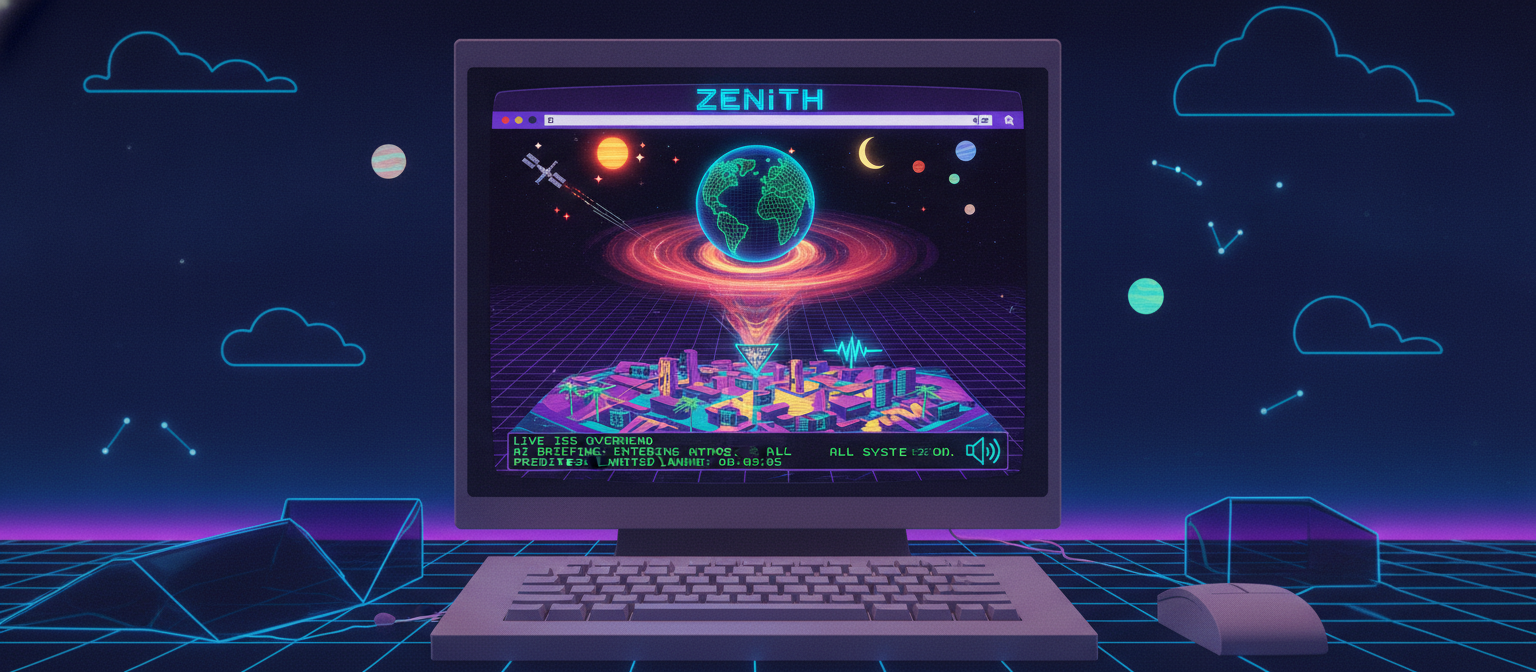
This was my submission for Weekend Challenge: Passion Edition.
What I Built Link to heading
The theme was passion, and mine has always been the sky and everything beyond it. Day or night, there’s a specific kind of awe in remembering that the sky isn’t a backdrop. It’s real, it’s happening right now, and every point of light is an actual place. Night is simply when you can see the most of it. I wanted to put that feeling into a browser tab.
Zenith takes your location, cinematically lowers you from orbit down onto your exact spot on Earth, and becomes a first-person view of your real sky, one you can drag to look around.
Every star is where it actually is. The Sun, the Moon, and the visible planets are computed for your latitude, longitude, and this exact minute, and placed where they truly are. It isn’t a fixed picture either: the whole sky rotates slowly in real time, so stars rise and set while you watch.
Tap any object and you travel to it. The camera flies out through the real starfield, the object grows from a point into a detailed close-up, and a short, grounded briefing appears telling you what you’re actually looking at, from where you’re standing, right now. A warm voice reads it to you.
Stay a while and Zenith reminds you that there are people over your head: it shows how many humans are in space this moment, by name, and draws the real International Space Station crossing your sky whenever it’s above your horizon.
Not information about space. The quiet, enormous wonder of looking up and knowing, for a moment, exactly what you’re looking at.
Demo Link to heading
Live: https://zenith-rgerjeki.vercel.app
A short walkthrough: the descent to your location, dragging the real sky, and flying to a planet for an AI briefing read aloud in a warm voice.
Code Link to heading
How I Built It Link to heading
Deliberately lightweight: Vite + vanilla JavaScript, no framework, with Three.js for the descent, the interactive sky, and the fly-to-an-object view. The real astronomy is the heart of it:
- The stars are real stars. Around 8,900 naked-eye stars from the HYG database (which builds on the Yale Bright Star Catalog), each placed at its true altitude and azimuth for your location and moment, tinted by its real color temperature (Rigel really is blue; Betelgeuse really is red), drawn as a single GPU point cloud.
- The sky actually tracks. The whole celestial sphere rotates about the celestial pole at the sidereal rate, and a shader clips anything below the horizon, so stars and planets rise and set correctly over time.
- The Sun, Moon, and planets are computed, not faked, with astronomy-engine: topocentric altitude/azimuth, distance, and the Moon’s real phase, all client-side, no key.
- The ISS is live from wheretheiss.at (polled every few seconds and smoothly dead-reckoned in between); the “humans in space” list comes from Open Notify.
Google AI (Gemini) writes the briefings Link to heading
When you tap an object, a Vercel serverless function builds a prompt from that object’s real, computed data (its distance in light-years or light-minutes, direction, brightness, phase) and asks Google Gemini for two to four vivid, grounded sentences, with strict instructions never to invent a number. That’s what turns a dot on a screen into “that steady point, low in the east, is Jupiter, 720 million kilometers away, a silent reminder of the scale of the neighborhood we call home.” The API key stays server-side, and it degrades gracefully: if the model is busy it falls back to a lighter Gemini model, then to a locally-written line.
ElevenLabs gives it a voice Link to heading
Reading is one thing; being read to is another. Each briefing is spoken aloud by a warm voice through ElevenLabs (again via a serverless proxy, key server-side). Because the free tier is small, I added a fallback I’m genuinely proud of: if ElevenLabs is ever unavailable, narration switches to Kokoro-82M, an open-weight text-to-speech model that runs entirely in the browser (WebGPU, with a WASM fallback). No key, no quota, so the sky always has a voice while ElevenLabs stays the premium default.
Everything else degrades gracefully too: geolocation falls back to typing a city, and every external call has a plan B, so it holds together in the real world.
Prize Categories Link to heading
- Best use of Google AI: Gemini writes every celestial briefing, grounded in each object’s real computed data (and never allowed to invent numbers).
- Best use of ElevenLabs: ElevenLabs narrates the briefings aloud, with an open-weight in-browser fallback (Kokoro-82M) so the narration never breaks.
Built this weekend, from an empty folder. Thanks for reading, and I hope it gives you the same small jolt of wonder it gives me. Go outside after, too.